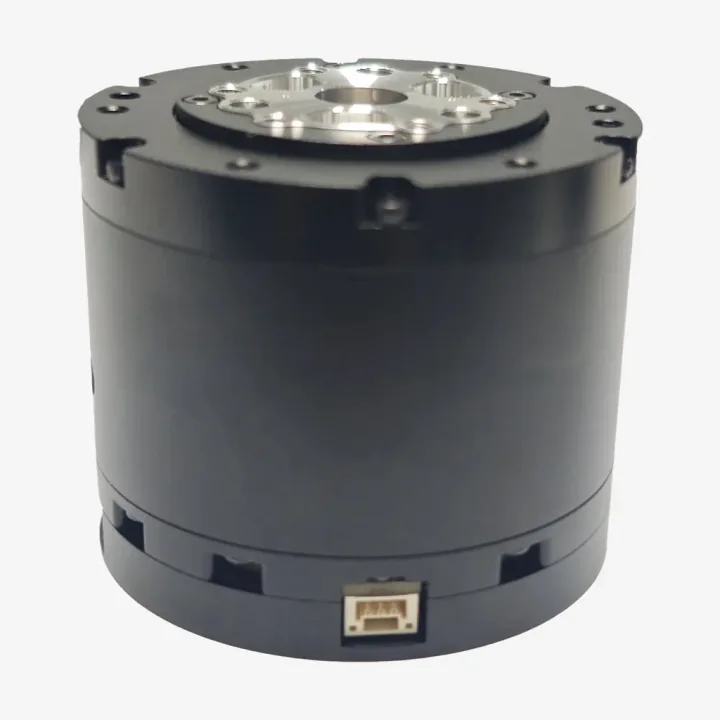
What the DM-J4310 is
A complete joint in one 57 mm unit: brushless motor, FOC driver, 10:1 reducer, crossed-roller bearing and two 16-bit magnetic encoders, one on the motor and one on the output. It is controlled over CAN, so several motors can share one bus.
Electrical and mechanical data (24 V version)
- Torque: 3.5 N·m rated, 11 N·m peak (12.5 N·m with the higher over-current setting).
- Speed: 120 rpm rated, 200 rpm without load.
- Current: 4.9 A rated phase current, up to 20 A peak.
- Control: CAN at 1 Mbps in MIT, velocity or position mode; UART at 921600 bps for setup.
- Mounting: 4 × M3 at the back, 6 × M3 on the output flange; Ø57 × 46 mm, about 325 g, IP23.
Protection
Driver over-temperature cut-off at 120 °C, plus user-set limits for motor temperature (up to 100 °C advised), over-voltage (up to 32 V advised), over-current and under-voltage (supply of at least 15 V advised), and a stop when CAN messages stop arriving.
In the box
The motor with its driver, a 100 mm XT30 (2+2) lead for power and CAN, and a 300 mm GH1.25 3-pin cable for the serial setup port. The bundle option adds a USB-to-CAN debugger.
Specifications
- Torque
- 3.5 N·m rated, 11–12.5 N·m peak
- Speed
- 120 rpm rated, 200 rpm no load
- Supply
- 24 V version; 15 V minimum advised
- Reducer
- 10:1, alloy-steel gears, crossed-roller bearing
- Encoders
- 2 × 16-bit magnetic (motor and output side)
- Control
- CAN at 1 Mbps; MIT, velocity and position modes; UART for setup
- Size and weight
- Ø57 × 46 mm, about 325 g
- Connectors
- XT30 (2+2) power with CAN, two ports for daisy-chaining
Compatibility checks
- You need a 24 V supply and a USB-to-CAN adapter to run it; the bundle option includes the adapter.
- Stock of this motor is small; we confirm availability before you pay.
- Set the CAN ID and limits with the maker's tool before mounting it in a joint.
